Exa 3.0 Search API Tops Perplexity, Brave and Parallel on 8 Benchmarks
Exa 3.0 is a search API upgrade from Exa. It adds a larger embedding model, Exa Lite at $4 per 1,000 requests, and Dynamic Highlights, and leads 8 benchmarks Exa ran itself.
Cloudflare has previewed Clairic, a System One extraction model on Workers AI that returns typed values with confidence scores in one forward pass. It costs $0.10 per million input tokens and charges nothing for output.
Inception released Mercury 3, a diffusion LLM it says runs at 1,068 tokens per second with a 1M-token context. On Inception’s own table it leads GPT-6 Luna and Claude Haiku 5.5 on 8 of 12 benchmarks.
Nace AI released Drex Max, a multimodal decision model that reads text and screenshots and returns calibrated probabilities. Nace reports 67.59 on Decision Index 0.3.2 at $0.06 per 1M input tokens.
MiniMax has released M3.1 Flash, a 428B-parameter MoE model with about 23B active parameters and a 1M-token context. API pricing is $0.15/$0.60 per 1M tokens, with weights due October 23
NVIDIA has released the full Run:ai GPU orchestration platform as open source under Apache 2.0. The release includes KAI Scheduler, CUDA 13.4 GPU fractioning, quota management, and a local Kind dev environment.
Mistral released Timestral, a time series foundation model family from 5M to 209M parameters. The 209M model leads GIFT-Eval, TIME and fev-bench among zero-shot models and runs on CPU.
An AI agent that reads the web pays 2 kinds of cost. The first is the retrieval charge: what a search or fetch API bills per request. The second is model processing: content passed from retrieved pages into an AI model consumes tokens, while reasoning and generated responses add further costs.
Google Research released Harness2, an Apache-2.0 framework that rewrites an agent’s harness at test time. One refinement step lifted GLM-5 by 11.5 points on WorkBuddy-Bench with no weight updates.
In this tutorial, we implement Structured Data Models, NVIDIA’s new library that puts several pretrained foundation models for tables behind one PyTorch interface, and use it to make predictions without training.
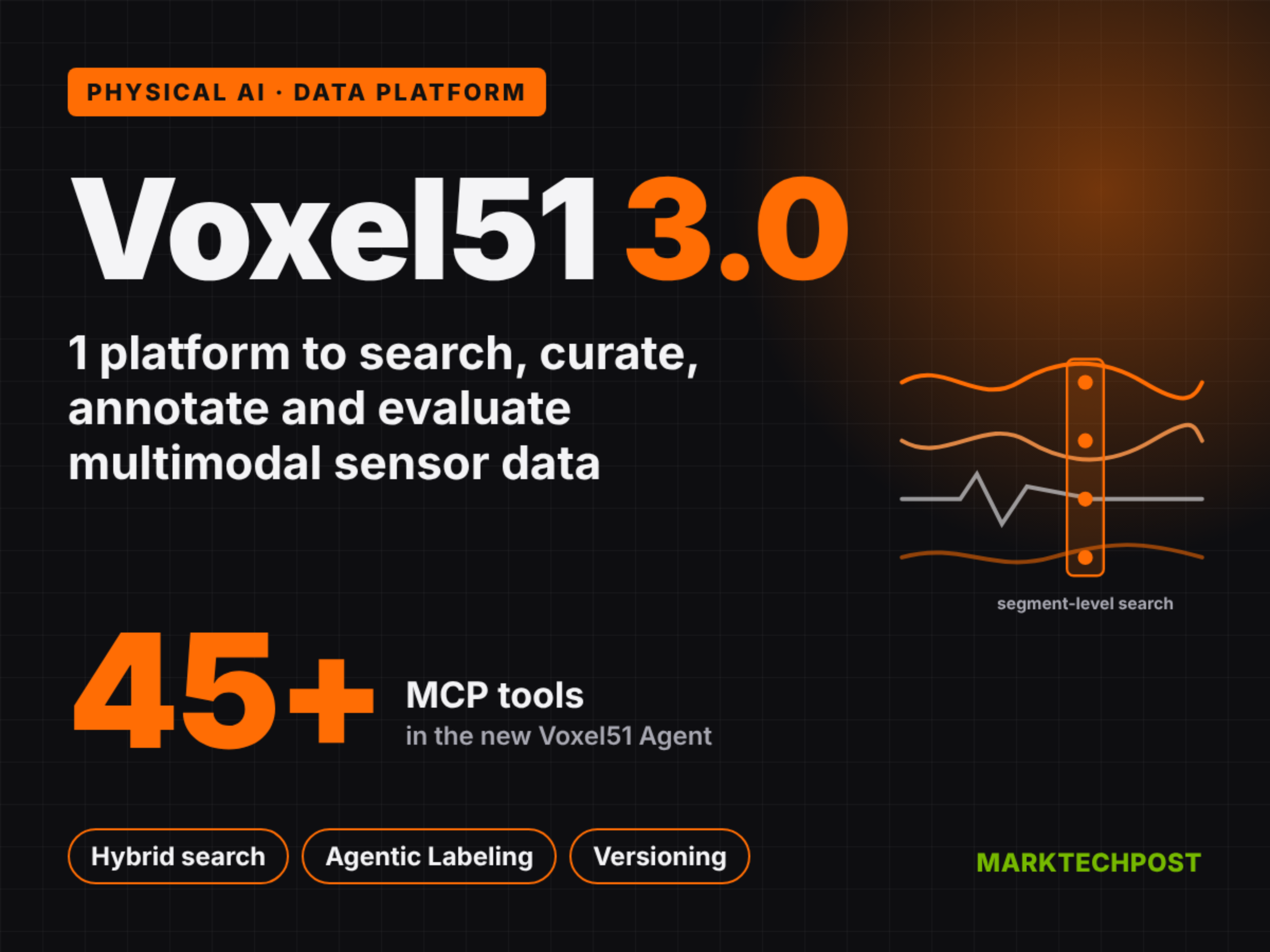
Voxel51 3.0 merges search, curation, annotation and evaluation of multimodal sensor data into one platform for physical AI teams. It adds Voxel51 Agent with 45+ MCP tools, dataset versioning, and a free self-service tier.
Kyutai, with Inria and École des Ponts, has released REKI, a 2.4B vision-language-action model (VLA) for robot manipulation. The REKI vision-language-action model is pretrained only on public data. It also carries a cheap memory of its recent past.
DeepSeek has just released DeepSeek-V4.1-Flash-1017, a new checkpoint of its V4.1-Flash model. It is live on the DeepSeek website, app and API. DeepSeek claims stronger scores, faster task completion and shorter outputs than the September V4.1-Flash release.
TypeSafe launched Jev on September 15, 2026. It is a decision model, not a chatbot. You define the allowed answers, and Jev returns a label, a score or a yes/no probability. In about 4 weeks, at least 20 Jev alternatives shipped.
StepFun has released Step 5 Preview as open weights. FP8 and BF16 checkpoints are live on Hugging Face and ModelScope. Step 5 Preview is a sparse Mixture-of-Experts model from StepFun built for long-horizon agentic work.
Perplexity has open-sourced SPACE, the sandbox platform behind every task in Perplexity Computer. The Perplexity SPACE sandbox gives each agent task its own Firecracker microVM. Credentials and outbound traffic are controlled from outside that VM. The code ships under Apache 2.0 on GitHub.
Liquid AI released d1-ultra, a text and image decision model that returns calibrated probabilities in 1 forward pass. It scores 65 on the Artificial Analysis Decision Index and costs $0.042 per million input tokens.
Meta released Muse Spark Open, an 816B-parameter open-weight MoE model with 42B active parameters and a 1M-token context. It leads open models on MCP-Atlas and runs on 2 M5 Ultra Mac Studios.
NVIDIA released Nemotron 3.5 Super VL, an open 120B-parameter multimodal MoE model with 12B active parameters, 1M-token context and NVFP4 weights that run on 1 DGX Spark, plus 2 Bolt edge models.
Introduction Teams shipping AI agents at scale keep running into the same pattern. Even agents built on top-tier models like Fable and Astra struggle to carry out complex, end-to-end tasks inside a specific product consistently enough to deploy.
At Open Source Summit Europe 2026, openKylin outlined its vision for transitioning from resource management to intent management in the AI era.
TypeSafe AI released Jev 1.14 under the jev-preview alias. The System One model adds experimental image input, a Box bounding-box type and an opt-in 262k-token context, at $0.042 per million input tokens.
SpaceXAI just released Grok Voice 3.0. Grok Voice 3.0 is a SpaceXAI speech-to-speech model that listens, reasons, calls tools and speaks. It now ranks first on the Artificial Analysis Speech-to-Speech Index with a score of 86.9.
Datalab released OmniParseBench, an open OCR benchmark with 16,288 yes/no tests on 2,937 pages in 92 languages. Every score is a pass rate you can slice by tag, script or language.
65 aktif kaynak
20 Türkçe · 45 İngilizce