


MIT Technology Review AI
Latest news

Artificial Intelligence
Industrial Intelligence: The next growth opportunity for manufacturing
Every manufacturer has its own industrial intelligence. Some is documented, and some resides in the knowledge of experienced workers. Consider an experienced operator preparing to restart a line after a changeover.

Artificial Intelligence
Will the real Anthropic please stand up
This story originally appeared in The Algorithm, our weekly newsletter on AI. To get stories like this in your inbox first, sign up here. After weeks of frenzied speculation, Anthropic has filed its IPO prospectus.

Artificial Intelligence
The focus on AI safety disasters ignores everyday harms
Consider what passes for success in technology policy. An AI company promises that its chatbot will not encourage suicide. A social media platform makes it more difficult for children to buy fentanyl. These are important protections, and they should have existed all along.

Artificial Intelligence
Designing an AI serving harness built to last
The next competitive advantage in enterprise AI has less to do with which model you choose than with what you build around it. That’s an important shift.

Artificial Intelligence
The Foundations of Scalable AI
A scalable AI system requires a strong foundation. Data, engineering, platforms, operating models, and governance must converge to work as one.

Artificial Intelligence
Making the case for context-aware AI
Enterprise AI can generate recommendations, automate tasks, and help organizations make decisions faster. But without an understanding of how a business actually operates, even powerful models can miss the constraints and relationships that determine whether a decision is the right one.

Artificial Intelligence
AI’s hidden storage bill: What inference leaves behind
Ask most executives to picture the cost of AI and they’ll likely see GPUs—racks of accelerators with gigawatts of power—and a waitlist for silicon. But that picture leaves something out: Data storage costs. What happens to data after a model responds?

Artificial Intelligence
The new economics of enterprise AI
Imagine your company just discovered electricity. At first only a few machines run on it, and nobody worries about efficiency — consumption is low and the value is obvious. But once electricity becomes infrastructure, every process depends on it, and the question changes from “can we use it?”

Artificial Intelligence
AI adoption by industry shows what other sectors can learn
The current narrative around artificial intelligence in the workplace is largely driven by Silicon Valley. But treating the tech sector as an island misses the actual trends in technology adoption–tech is just the first industry in line.

Hardware
A visit to Samsung’s massive new semiconductor hub
Generative AI models run on powerful chips known as GPUs, which depend on stacks of specialized memory chips packaged with the processor. To meet growing demand for memory, Samsung is building a massive new semiconductor manufacturing complex in Pyeongtaek, South Korea.

Artificial Intelligence
Making the internet better for AI agents might make it worse for everyone else
This story originally appeared in The Algorithm, our weekly newsletter on AI. To get stories like this in your inbox first, sign up here. Until recently, you could divide internet users into just two categories: bots and people.

Artificial Intelligence
“We were looking at it wrong”: The explosive claim that’s upended the AI world
“I think I have good news about the nature of neural networks.”

Artificial Intelligence
AI researchers stranded Claude on a virtual desert island. It started to “play.”
What do AI agents do if you don’t tell them to do anything? The answer looks a lot like play. Researchers repeatedly stranded them alone on a virtual desert island for 30 hours in an experiment reminiscent of the movies Cast Away or Home Alone.

Artificial Intelligence
Open models have real benefits. Do they outweigh the risks?
MIT Technology Review Explains: Let our writers untangle the complex, messy world of science and technology to help you understand what’s coming next. You can read more from the series here. Late last month, Anthropic released a report arguing that the model GLM-5.3 poses a major cyberattack risk.

Artificial Intelligence
AI labs are buying data from dead startups to train their models
When Keelan Miskell began winding down his crypto startup this year, he didn’t think its data was worth much: the users were anonymous, the company just a few years old. But he’s since turned the firm’s digital archives into real money.

Artificial Intelligence
We’re putting too much faith in AI’s ability to say no
Ever since people first seriously contemplated giving machines an intelligence modeled on our own, there has never been any question that they would, like us, be able to say no. The sci-fi canon is full of stories of robotic disobedience. Most of these capers are, of course, cautionary.

Artificial Intelligence
Roundtables: A Conversation With the Creator of AI-Designed Viruses
Friday, October 16, 2026 Can AI design new life forms? In 2025, Stanford University PhD student Samuel King came up with a preliminary answer when he used a generative AI model to propose genetic blueprints for microscopic viruses.

Artificial Intelligence
AI breakthroughs in robotics won’t change your life any time soon
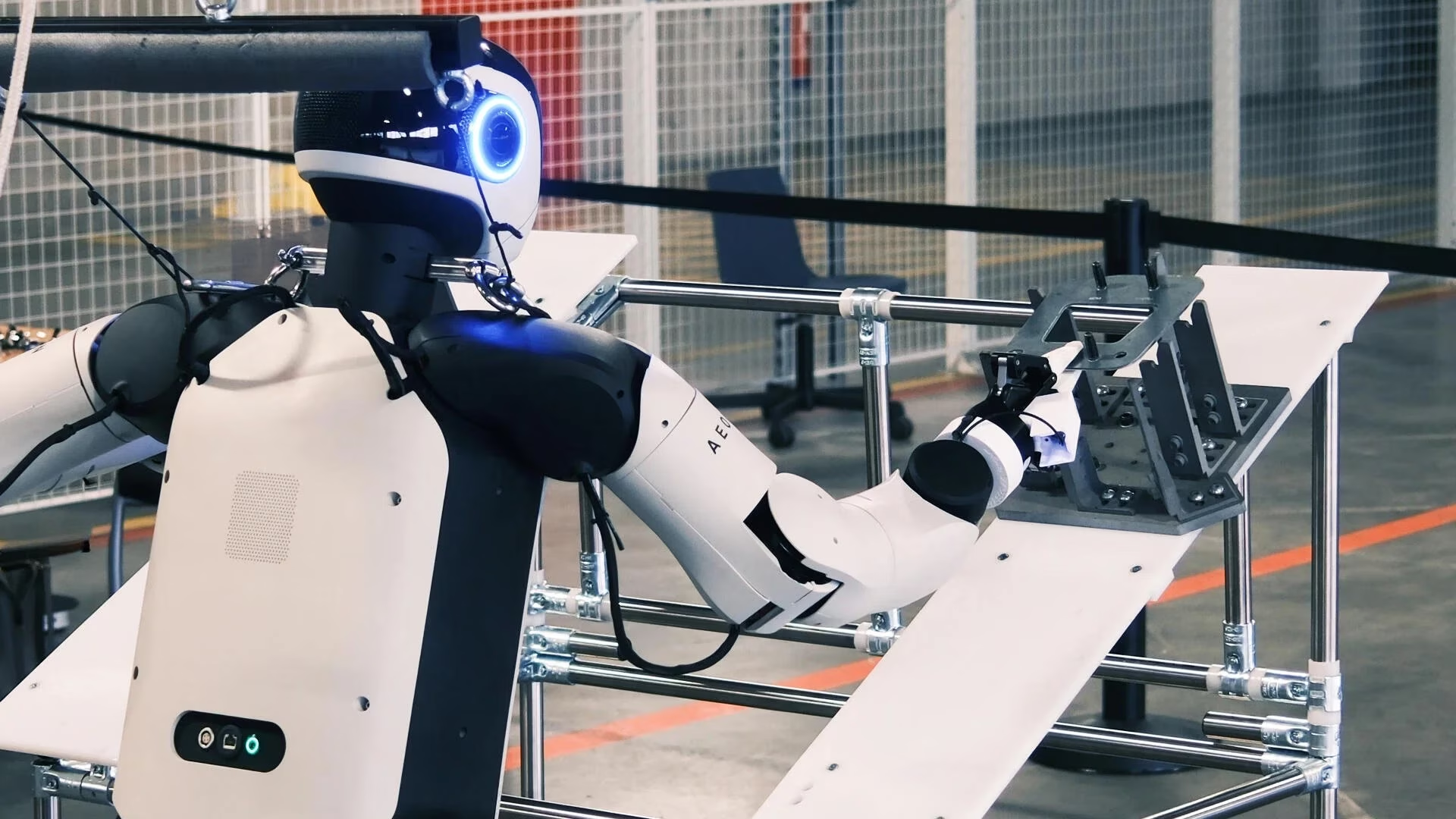
The story is a collaboration between MIT Technology Review and Aventine, a non-profit research foundation that creates and supports content about how technology and science are changing the way we live. A robot shaped like a human—white with a black head and torso—has been popping up on video feeds…

Artificial Intelligence
Building a safer path to autonomous industrial AI
Industrial AI is entering a new phase. After decades of predictive analytics and other specialized applications, advances in foundation models, physical AI, and agentic AI are making it possible to automate more complex tasks across industrial environments. But unlike AI that operates purely in the…

Artificial Intelligence
Connecting AI agents to enterprise knowledge
For all the data that AI systems continually amass and analyze, enterprise AI agents often suffer from a curious shortcoming: a lack of knowledge. More than data, knowledge is the understanding of what the data means in the context of individual organizations. AI agents need this understanding to…

Artificial Intelligence
Bringing predictive analytics to the agentic AI era
In 2026, the question for enterprise AI is no longer whether predictive models can outperform statistical forecasts—that argument is settled. The big question now is how to enable predictive systems to act on their own conclusions without drifting from business intent. The frontier has moved from…

Artificial Intelligence
People really hate AI, so why can’t they get enough?
Over the summer I talked to the CEO of Springboards, a startup building an LLM that’s designed to come up with a wider variety of responses than its mainstream rivals do. At the start of the call, he said something that’s been stuck in my head since: “We often say that we’re a self-loathing AI…

Artificial Intelligence
EmTech Future 2026: When AI Meets Everything
Yossi Matias, Vice President & Head of Google Research, explores how AI is beginning to reshape biology, infrastructure, manufacturing, and science, and why its greatest impact may come when it intersects with other fields. Step inside the newsroom with our MIT Technology Review editors for sharp…
Latest digest
Week 47
EN

Popular stories
-

-
The custom ROM situation is really interesting.
Android Police

-

-
-



Sources
65 active sources
20 Turkish · 45 English
All sources

