Artificial Intelligence
From In-Silico to Wet-Lab: Evaluating AI Protein Design Performance
In this tutorial, we analyze Anthropic’s 1,440 AI-designed protein binder dataset to benchmark 10 leading structure predictors.
In this tutorial, we analyze Anthropic’s 1,440 AI-designed protein binder dataset to benchmark 10 leading structure predictors.
Google Research and UNSW Sydney released GlucoFM, a self-supervised foundation model that splits a CGM trace into a slow physiological stream and a transient event stream instead of encoding it as one sequence.
Z.ai has released GLM-5.3-Flash, the first natively multimodal model in the GLM-5 series — a 320B-total / 18B-active MoE with a 1,048,576-token context window, MIT-licensed weights on Hugging Face, and API pricing at $0.15/M input and $0.50/M output.
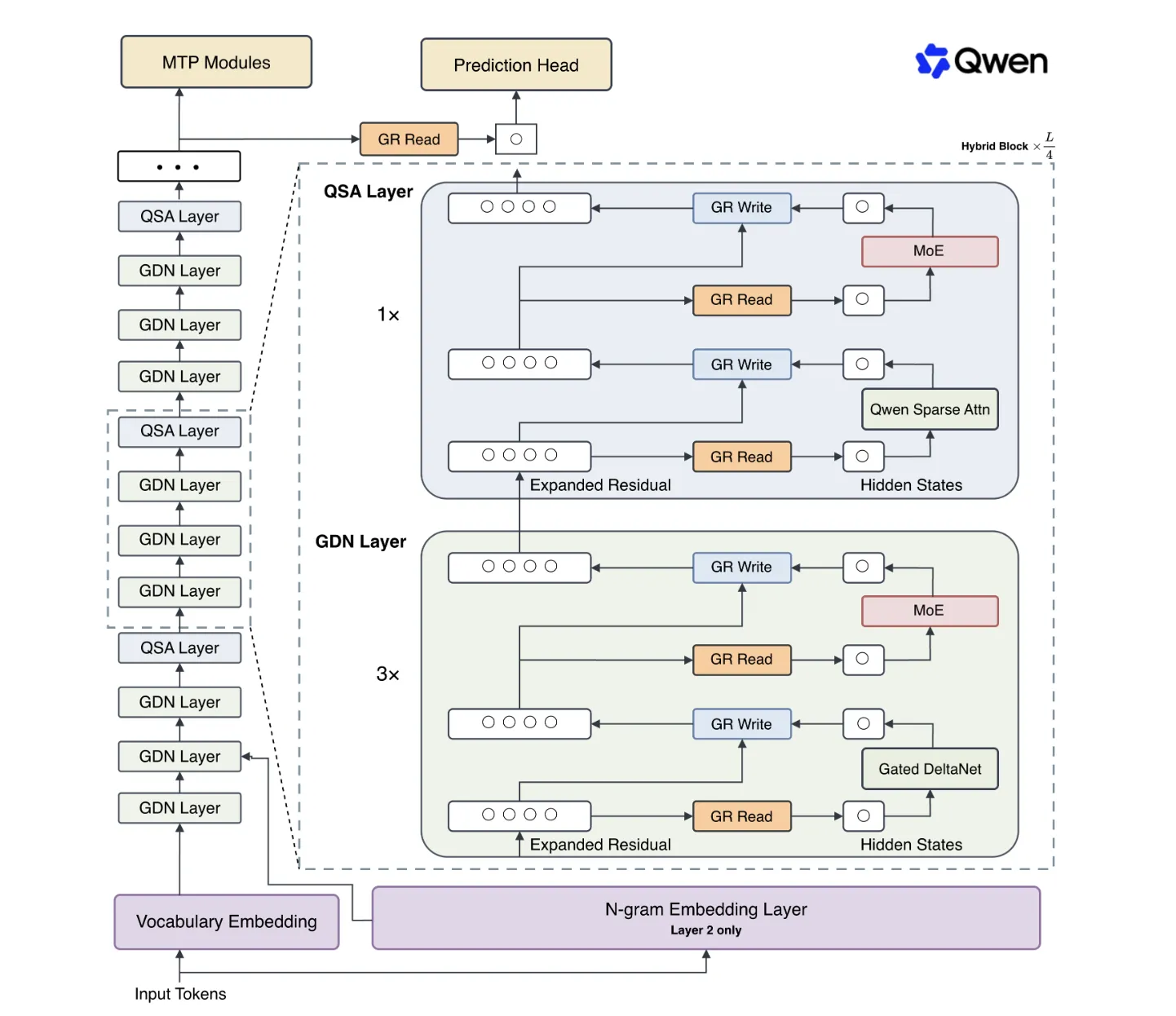
We look at Qwen3.8-Flash-Next, Alibaba’s open-weight multimodal Mixture-of-Experts model and an early preview of the Qwen4 architecture.
Four falsifiable conditions for agentic coding replacing juniors, tested against METR, OpenAI, DORA and Stanford primary source evidence
IBM has released Granite 4.2, a family of open reasoning language models in 3B, 8B, and 30B sizes, all under Apache 2.0. Every model exposes a thinking / low-effort / non-thinking switch and native tool calling.
Model cards report quality under server-class, full-precision conditions. Those numbers rarely predict how the same model behaves on a phone. This week, Liquid AI released Pipette.
Perplexity releases Portable Computer, packaging local models, harness, sandbox, and connectors into one system running on NVIDIA DGX Spark.
Training and serving frontier models is now a networking problem as much as a compute problem. Collective operations like all-reduce and all-to-all synchronize thousands of accelerators during training, and the slowest transfer sets the pace for the entire job.
Fastino released GLiNER2.5, replacing span enumeration with boundary prediction so entity width no longer costs compute. Three Apache 2.0 checkpoints ship at 74M, 194M, and 287M parameters, all CPU-runnable.
Generalist AI has released GEN-1.5, a robot foundation model that learns a new physical task from a single demonstration. Drop 3–12 seconds of sensorimotor data into its 30-second context window, and the robot performs the task. No gradient updates, no fine-tuning, no task-specific programming.
Framework that folds aggregate human movement into text-based place embeddings. Language models describe what a place is; they miss how it is used.
The five largest GPU neoclouds now run on very different models. CoreWeave and Nebius report to the SEC; Lambda and Crusoe are private and heading toward IPOs; Groq rebuilt itself as an inference cloud after licensing its LPU technology to NVIDIA.
In this tutorial, we explore a LabPlot-inspired scientific data analysis workflow in Python while preserving the structure and terminology of LabPlot’s aspect tree, analysis kernels, plotting system, and project model.
Harvey’s first post-trained model nearly doubles LAB task completion, but only one benchmark number survives independent verification today
FreeToken splits MoE cache misses between PCIe fills and CPU execution using measured bandwidths, unlocking frontier models locally
Build an end-to-end document intelligence pipeline with deepDoctection. This tutorial covers configuring layout analysis, DocTR OCR, and table extraction, while demonstrating how to implement custom services for entity recognition and generate structured JSONL data for your RAG workflows.
Vercel and Ora launched Is Agentic, a free audit scoring website readiness for AI agents across 118 checks.
In this tutorial, we explore how to design production-grade safety for LLM-based applications using the NeMo Guardrails framework.
Most teams treat ‘which model’ as the important decision. The harness engineering literature keeps pointing somewhere else. In LangChain’s Terminal-Bench experiment, changing only the harness—same model throughout—moved a coding agent from roughly 30th place into the top 5.
This tutorial explores AutoFigure, a practical toolkit for generating professional scientific figures directly from text descriptions and research papers.
72 active sources
27 Turkish · 45 English
All sources